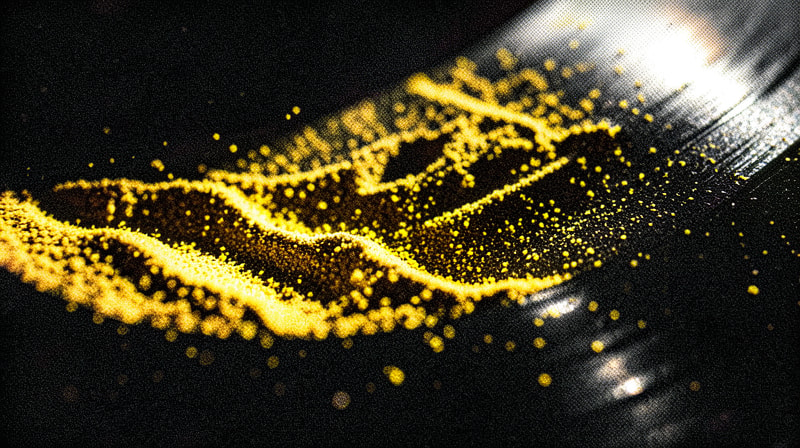

The Clyfford Still Museum in Denver opened a sound exhibition in May 2027. Clyfford Still was an abstract painter whose work is held in this museum, which preserves and exhibits his paintings. Five sound artists — Maria Chávez, Maya Dunietz, Kalyn Heffernan, Matana Roberts, and Michael Schumacher — each selected an abstract painting from Still’s work and composed a sonic interpretation. The pieces play in shuffled order across the museum’s largest galleries. Visitors move through rooms where sound, not light, sets the tone. The museum calls this Still in Sound. They call it access programming.
That is not what this is.
What the Clyfford Still Museum built, without appearing to know it, is evidence that the entire premise of the visual art museum — that painting speaks primarily to those who see it — is a design flaw, not a fact. When you translate a painting into sound, you are not making it accessible. You are admitting that the painting’s meaning was never locked inside what you see to begin with. The sound interpretation does not approximate the painting. It demonstrates that the painting was always doing something that exceeded the frame.
I have been saying this for fifteen years. Gallery directors nod. Then they build the ramp and consider the problem solved. The Clyfford Still Museum just spent institutional money and curatorial labor demonstrating my point, and they filed it under accessibility programming.
Here is what Still in Sound actually reveals. Co-curator Bailey Placzek selected additional paintings to hang alongside each sound interpretation — works that resonated with the compositions. The sound opened a relationship between paintings that the visual arrangement had not. The sonic logic created a new curatorial path. Not because sound is better than sight. Because sound does something sight cannot do alone, and the museum’s infrastructure was never built to acknowledge that.
Museums treat looking as neutral. That the eye is a camera. That the viewer walks in, the painting is there, the meaning transfers. But resonance is not a visual property. Duration is not a visual property. The way a room holds silence is not a visual property.
I know what that room sounds like. I worked in museum acoustics — the study of how sound behaves in gallery spaces — for six years before I admitted I was there for the wrong reason. I thought I was solving accessibility problems. I was actually documenting how much information a gallery destroys by privileging the eye. A marble floor does not only look expensive. It reflects high frequencies and absorbs low ones. You hear wealth before you see it. When a museum puts tactile labels on bronze sculpture but leaves the floor untreated, they are not meeting access needs. They are just telling you where the sculpture is. They are not telling you what the room is doing to your body while you stand there.
The Clyfford Still Museum hired Phillip David Stearns, a sound artist who works with electromagnetic fields and digital noise, to design an interactive sound experience in response to Still’s pastel drawings. Stearns creates sounds that resemble the hum and interference of machines and electrical systems — the sonic texture of infrastructure itself. Which is what a drawing is — infrastructure for looking. The pastel sits on paper because paper holds pigment in a way air does not. Stearns made that visible by making it audible. Not a metaphor. A structural correspondence.
But the museum does not bill it that way. They bill it as: a special experience. For whom? The phrasing implies: for people who need an alternative to looking. What the phrasing does not say: this might be a better way to understand the drawing than standing in front of it and staring.
I went to an exhibition in 2019 where they had installed audio descriptions on headsets. A recording. Fixed. I stood in front of a Rothko and listened to someone tell me the proportions of the color blocks, the sequence of the layers, the dimensions of the canvas. All correct. All useless. What I needed was not a description of what the painting looked like. What I needed was an account of what the painting was doing — what it asked of the room, what it did to duration, whether it pulled you in or held you at distance.
The Clyfford Still Museum accidentally built that. Then they called it a one-time project. The exhibition closes in February 2027. After that, the sound interpretations disappear. The paintings go back to being visual objects. The museum returns to its premise: that painting is for people who see.
Still in Sound runs for nine months. Then the museum unveils fifteen new paintings over fifteen months — one per month, never seen before. Standard chronological display. No sound. The accessibility project ends. The real collection continues.
Sound told the museum what the paintings were doing.