
The Giardini in Venice sounds like money. I know this because in June 2019, a colleague recorded the opening night event for me — not the speeches, not the champagne clinks, but the ambient field: heels on stone, the territorial echo of national pavilions spaced just far enough apart to make each country’s art feel sovereign, the particular reverb of a room built in 1895 to announce European supremacy through architecture. I listened for eleven minutes. The recording told me more about what the Biennale is than any catalogue ever has.
The Biennale is a major international art exhibition held in Venice every two years. This week the 61st edition opened under protest. The Russian pavilion stayed shut. Artists and curators withdrew over Israel’s inclusion. Lubaina Himid, a British artist known for her paintings that address colonial history, filled the British pavilion with works that pick at colonial wounds. Rain fell. A seagull nested on a sculpture. The art press is calling it a crisis of legitimacy.
I want to talk about a different room.
In March 2023, I stood in the entrance hall of the Arsenale — the other main Biennale venue, a former shipyard with the acoustic signature of a cathedral built for war. Stone floors, vaulted ceilings, hard parallel walls. Every footstep returned to me three times. I could map the space in seconds. I could also tell, from the density of reflections, that the crowd was enormous and moving in one direction, like cattle.
What I could not do was find the art.
The Arsenale’s layout funnels visitors through a sequence of rooms. Sighted visitors follow sight lines, wall labels, projected light. I followed sound. And the sound told me almost nothing, because contemporary installation art — the kind the Biennale rewards — is overwhelmingly silent. A video projection makes no sound until you are standing in front of it. A painting on a wall is acoustically identical to the wall. The rooms were full of art. I could not locate any of it without asking strangers to describe what was nearby.
I am not complaining about access. I am describing what the architecture knows and what it refuses to say.
Here are the two rooms.
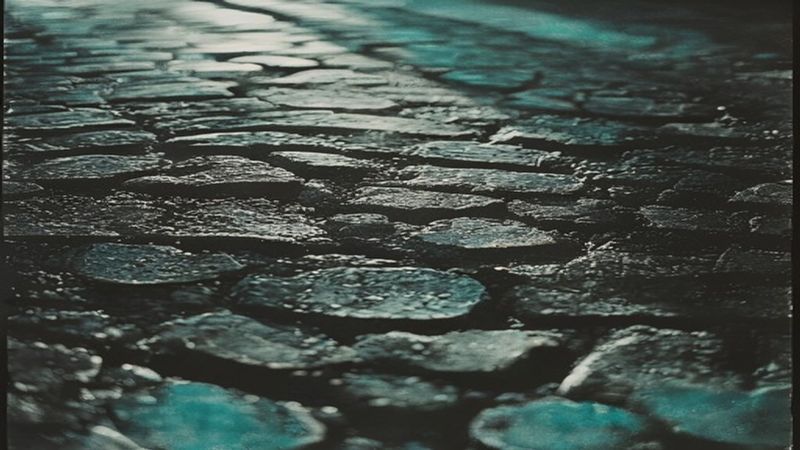
Room one: the Giardini, May 2026. Protesters hold signs. Artists refuse to show. Curators resign. The structure of the Biennale — nations competing in purpose-built pavilions on a landscaped island — is being challenged as a relic of nationalism, colonialism, complicity. The challenge is real and necessary. An Italian artist who filled her pavilion with industrial wreckage in 2009 once said the Giardini’s layout “makes every country perform statehood whether they want to or not.” The architecture forces the politics. The cobblestones, the gravel paths, the stepped entrances — these are not incidental. They are the Biennale’s first curatorial statement. They say: this was built for a specific body moving through space in a specific way, and that body is the only one that matters.
Room two: a basement studio in Rotterdam, January 2024. I sat with Tarek Atoui, an artist who creates instruments that can be played by deaf musicians by translating sound into vibrations and spatial movement. His work starts from the premise that sound is not primarily auditory. It is tactile. It is spatial. It moves through floors, through bone, through water. He showed at the Sharjah Biennial in 2023, not Venice. He told me something I have not stopped thinking about: “The concert hall is an argument about who gets to feel music. I am interested in rooms where the argument has not been settled yet.”
The Biennale’s crisis is about settled arguments. National pavilions. Geopolitical allegiance. Who gets a room and who does not. The protesters are right: the structure is rotten. But the structure they are protesting is the visible one. The one I hear — the acoustic architecture of exclusion, the way the buildings themselves sort bodies into those who navigate effortlessly and those who do not — never makes the list of grievances.
You might say: of course it doesn’t. The protesters are focused on war, on occupation, on political complicity. Fair. But the Biennale has run sixty-one editions. In that time, the art world has reckoned with colonialism, with gender, with race, with sexuality, with environmental destruction. Each reckoning produced new curatorial frameworks, new pavilions, new language. The one reckoning that has not happened — the one that would require the Giardini itself to change, not just what hangs inside it — is the one about which bodies the architecture was built to hold.
Amanda Cachia, the Australian curator who is under four feet tall, organized an exhibition in 2012 where she hung all the work at her eye level. Sighted visitors had to crouch. The room sounded different at that height — I know because she described the acoustic shift to me in a phone call in February 2024. Sound bounced off bodies differently when those bodies bent. The room changed when the bodies in it changed. The art did not.
The Biennale does not need better access guides. It does not need a ramp bolted to the side of the British pavilion. It needs to hear what its own rooms are saying. A room built for one kind of body produces one kind of silence. That silence is not empty. It is full of the people who are not there, whose absence the architecture has already decided.
This week in Venice, a seagull built a nest on an outdoor sculpture and everyone laughed.
The seagull heard the room before anyone else did.