A newspaper article this week invites parents to forget galleries entirely — take the children to a sculpture park, it says. No white walls. No string barriers. No beady-eyed attendants. Just green space and mud and freedom. I read it twice, because the first time I thought I’d missed the joke.
I have been to Yorkshire Sculpture Park, an outdoor art venue in West Yorkshire. In March 2023, on a Tuesday, grey and wet. I went because a friend told me the Henry Moores — large bronzes with holes and hollows cast through them — make the wind behave differently. She meant it as poetry, but she was right. A large bronze with a hole through its center does something to air pressure that a solid form does not, and you can hear it. The wind changes pitch as it threads through the opening. I stood in front of one for ten minutes, shifting my weight from foot to foot, and the sculpture told me more about its own shape than any audio guide ever has.
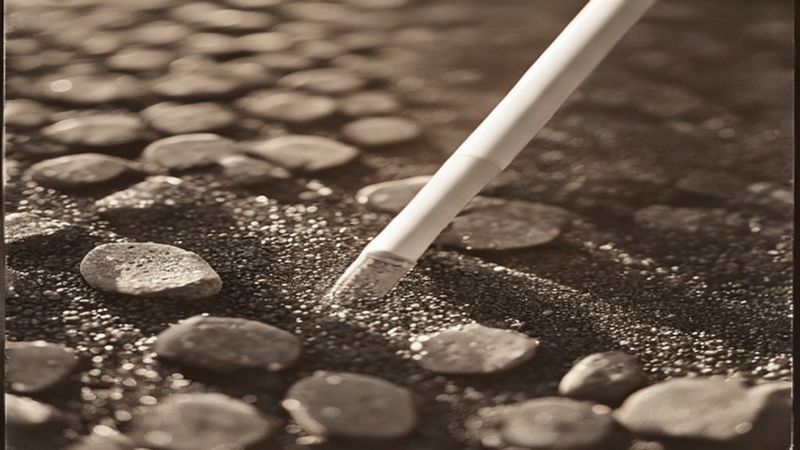
Then the path turned to grass, and the grass turned to mud, and the mud took my cane out from under me. Not dramatically. Just a slow suck, the kind where the ground swallows the tip and doesn’t give it back in time for the next step. Every tap returned the same dead thud. No echo, no rebound, no information. Mud is acoustically silent. It tells you nothing about what’s ahead.
Here is the thing the article gets exactly backwards. A gallery with hard floors, high ceilings, and right angles is not a hostile environment. It is a legible one. My cane on marble gives me the room’s dimensions in three taps. My footsteps on polished concrete tell me where the wall is before I reach it. The dreaded white cube — the space that art criticism has spent decades calling sterile, elitist, exclusionary — is the most acoustically transparent room I have ever been in. Every surface answers back.
The sculpture park does not answer back. Grass absorbs. Soil absorbs. Gravel scatters sound in every direction, which is worse than absorbing it because the information arrives in fragments rather than a clean signal. The “freedom” the article celebrates is a freedom from legibility. For a child in a buggy, that might be fine. For a body that navigates by listening to what the ground says, it is not liberation. It is noise.
You’re thinking: but fresh air, open space, surely that’s better than being trapped indoors? I understand the appeal. The outdoors is coded as democratic. Open land feels like it belongs to everyone. But Georgina Kleege, a scholar of disability and visual culture, made the point years ago that blind people know more about how visual spaces are organized than sighted people do, because sighted people never have to think about it. The same works for acoustics. The “natural” landscape is not neutral. It has been designed too — designed by drainage, mowing schedules, path materials, the placement of benches. The design just pretends it isn’t there.
Zen Circuit, a disability rights writer and activist, wrote recently about sensory overload in cities, and I want to be precise about where he and I disagree. For him, the problem is too much signal. Too many inputs competing for a brain that processes sensory input differently from the norm. For me, the problem is too little. A field of wet grass gives me almost zero acoustic return. His ideal — a quieter, less cluttered environment — is my worst case. The policy that calms his nervous system strips out my navigation. Same stimulus. Opposite failures. This matters because “accessible sensory design” has become a single category, as if every non-standard body needs the same thing. It does not. Soft surfaces, natural materials, sound-absorbing landscaping — these are solutions to one problem that create another.
In August 2018 I visited the Kröller-Müller Museum in the Netherlands, which sits inside a national park and has one of the largest sculpture gardens in Europe. The indoor galleries have stone floors. My cane sang. I could hear the rooms opening ahead of me, feel their ceiling heights change, know when a wall was close. Then I walked out into the garden, and within four steps the world went matte. The gravel path gave me a rough direction. Everything else — the sculptures, the trees, the distance to the next turn — went quiet.
The museum knows this, I think. They’ve installed some paved routes through the garden. But the sculptures are not on the paved routes. The sculptures are in the grass. You leave the path to reach them. The path is the access. The art is off-access. Nobody frames this as a barrier because it happens in nature, and nature is supposed to be good for you.
Lebbeus Woods once argued that walls are not enclosures but instruments — they create the conditions for experience, not the limits of it. The white-walled gallery is an instrument I can play. The sculpture park is an instrument with the strings cut.
I went back to that Henry Moore in the rain, the wind still threading through the hole in the bronze, and the sound was the only thing in that entire landscape that told me exactly where I was.