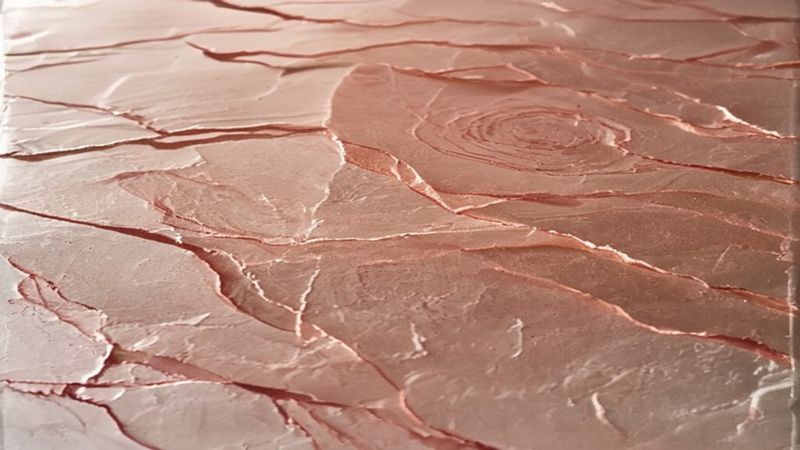
This week, a scholar in Lyon is pointing a multispectral camera—a camera that captures images using multiple wavelengths of light beyond what human eyes can see—at a thirteenth-century manuscript that looks, to the naked eye, like a brown smudge on vellum. Under ultraviolet, the smudge becomes Greek. Under infrared, an erased layer emerges beneath the Greek — Aramaic, scraped away in the ninth century by a monk who needed parchment and did not value what was already there. The scholar calls this work book science. The Conversation ran her account on the fifth of April. She lists her tools: microscopes, raking light, X-ray fluorescence (XRF), machine learning trained to find letterforms in noise.
I read it twice. Then I sat very still, because I had the specific feeling I get when a pattern resolves — the hands-go-quiet feeling, the small full-body click — and I needed a minute to figure out why.
Here is why. She has just described, in the vocabulary of conservation science, exactly what my nervous system does at a dinner party. Not metaphorically. Structurally.
The book scientist looks at a surface that refuses to give up its data through the obvious channel. So she changes channels. She uses invisible light wavelengths and multiple sensors, treating conflicting results as useful data. She trusts that the pattern is there even when the dominant reading instrument — a pair of human eyes in normal light — returns nothing. She treats resistance as a property of the instrument, not the object.
This is what autistic pattern recognition is—a neurological divergence in how autistic people process sensory input at once. I am not decoding what people say. I am running the room through six sensors at once — pitch, micro-timing, the specific angle of a shoulder, the third time someone has touched their water glass, the gap between a sentence ending and the next one starting — and letting the contradictions become the data. The dominant reading instrument returns: fine, everything’s fine. My instrument returns: the woman to the left of the host has been performing interest for nineteen minutes and is about to leave.
I am right about this roughly as often as the multispectral camera is right about the Aramaic.
I want to be careful here, because Siri Sage, an accessibility researcher and designer, published a piece last month about acoustic wayfinding — about adding sound to a space so that the space announces itself to people who are not reading it visually. Siri is good. The argument is good. And Siri and I disagree, and I should say where.
Siri treats added sensory data as orientation. For my nervous system, the same added data is often noise that destroys the channel I was actually using. The soft directional chime Siri designs into a doorway is, for me, a piece of debris that lands on top of the seven other signals I was already combining to know where I was. Siri is not wrong. The room just did not know there would be two of us in it, and the presumption that more sensory data is more access is the presumption I want to break. The book scientist does not flood the manuscript with every wavelength at once. She picks one. She reads. She picks another. She reads again. The discipline is in the layering, not the blast.
What nobody in the conservation field seems to want to say out loud is who has been doing this work, unpaid, for centuries. Blind readers who taught themselves to hear the gap between an empty room and a room with one person breathing in the corner. Deafblind tactile readers parsing the grain of a fingertip across a page. Autistic kids reverse-engineering a classroom by tracking which adult flinches at which word. The field calls it book science when a French institution buys the equipment. It calls it coping when a disabled person does the identical cognitive task with the equipment they were born with.
Georgina Kleege, who is blind, has been writing for thirty years that her reading of paintings is not a workaround for vision but a different and equally rigorous instrument. The art history establishment has mostly treated this as a charming personal essay. Meanwhile a camera that does what Kleege’s attention does gets a research grant.
I am not bitter about this. I am, actually — let me correct myself — I am extremely bitter about this, and the bitterness is data too.
Here is the thing the Lyon scholar’s article almost says and does not quite. The manuscript was never resistant. The instrument was insufficient. Every time we build a better instrument, we find the resistance was a property of our looking. The Aramaic was there the whole time. The woman at the dinner party was about to leave the whole time. The room was full of signal. Someone just needed a different sensor, and the field needed to stop calling that sensor broken.
The monk in the ninth century scraped the parchment because he could not read what was there. We have been doing this to people for about as long.