
In July 2023, the Grand Egyptian Museum posted promotional material calling disabled visitors “People of Determination” and announcing a fully accessible cultural experience. Six thousand kilometres away, in Sheffield, a disabled man named Doug Paulley had already spent a decade in and out of courts over a bus access dispute. In 2007, a bus driver refused to ask a passenger with a pushchair to move from the wheelchair space so Paulley could board. When the bus company argued they could only request, not require, passengers to move, Paulley took the case to the UK Supreme Court. He won in January 2017. The ruling established that bus companies have a legal obligation to enforce wheelchair space access, not merely ask for it politely. It was a landmark decision about the ordinary, everyday right to public transport. The ruling changed nothing about the bus. It changed everything about the word for what happened to him. What happened to him was discrimination. Not a lack of determination.
The Grand Egyptian Museum is, by most accounts, a staggering building. Over 100,000 artefacts. A site that cost more than a billion dollars. The ramps exist. The lifts exist. The accessible toilets presumably exist. I have no reason to believe they don’t work. This is not an article about broken lifts.
This is about what happens when you build a ramp and then describe the person using it as someone who has overcome.
“People of Determination” started in the UAE in 2017. Sheikh Mohammed bin Rashid Al Maktoum, the ruler of Dubai and prime minister of the UAE, announced it as a replacement for “People with Special Needs,” which was itself a replacement for older Arabic terms nobody wants to repeat. The phrase spread across the Gulf states and into Egypt. It sounds generous. It sounds like respect. It reframes disabled people as strong, resilient, admirably tenacious in the face of hardship.
Here is what it actually does: it makes disability a character trait instead of a political condition.
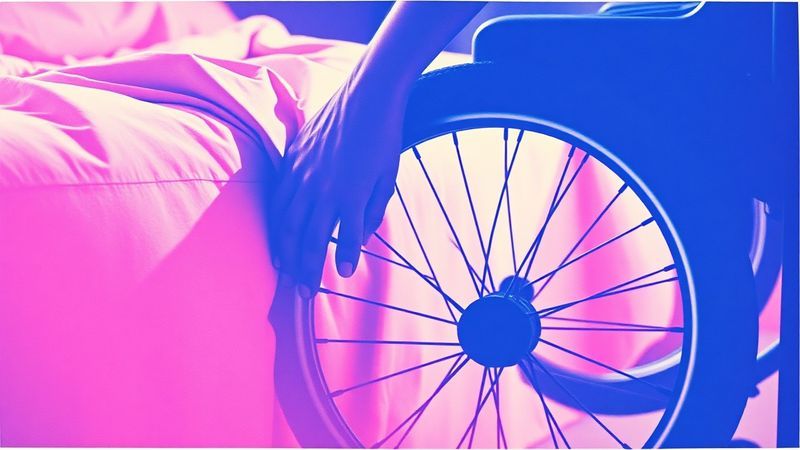
Mike Oliver, a British sociologist who pioneered disability studies, spent decades on this distinction. In 1983, he developed what became known as the social model of disability—the idea that disability is not caused by a person’s body, but by how society is organized around non-disabled people. He drew the line between impairment and disability in 1983 and the world has been trying to blur it ever since. Impairment is what my body does. Disability is what the world does to my body. The social model is straightforward: a flight of stairs disables me. My spine does not. When you call me a Person of Determination, you move the problem back inside me. You make my access a product of my personal grit rather than your legal obligation.
Someone will say: it’s just a word. Language evolves. The intent is positive.
The intent is irrelevant when the effect is structural.
If I am determined, I don’t need enforceable rights. I need encouragement. A ministry can celebrate me in a press release and defund the transport budget in the same fiscal year. I watched this happen in Cairo in October 2022, when new accessibility guidelines for public buildings were announced the same month the metro system cut its disability fare programme. Determination, it turns out, is cheaper than infrastructure.
Sunaura Taylor, a disability activist and filmmaker, wrote in Beasts of Burden that the category “normal” does the same work across species: it decides who moves freely and who gets managed. In her book, she argues that animals and disabled people share the experience of being controlled and confined by systems that define them as less than fully human. The museum is a perfect case. The building is accessible. The language managing its visitors is not. The Grand Egyptian Museum’s own promotional copy describes disabled visitors as people who have “defied challenges.” I did not defy a challenge this morning. I transferred from my bed to my chair, checked my tire pressure, and went outside. The pavement on my street has a two-inch lip where the council repaved in August 2021 and didn’t bother to taper the edge. That lip is not a challenge I am defying. It is a failure someone is responsible for.
The museum’s inclusion model checks every box. Tactile paths. Wheelchair-accessible galleries. Staff trained in “dealing with” People of Determination. That phrase appeared in their training materials. Dealing with. As though I am weather.
Doug Paulley didn’t need anyone to deal with him. He needed the bus driver to say: “Could you fold the pushchair so this man can board?” The driver didn’t. First Bus argued it couldn’t compel passengers to move. The Supreme Court said the policy of merely requesting was not enough. Paulley’s solicitor, Chris Fry, told the Guardian in January 2017 that the ruling was about “the ordinary, everyday experience of getting on a bus.” Not heroism. Not determination. A bus.
I think about Paulley every time I read a press release that calls a building “fully accessible” and then describes its disabled visitors in the language of inspiration. The building says: you belong here. The language says: and isn’t it wonderful that you tried. The architecture gives me a right. The branding takes it back.
Liz Carr said it plainly during a 2015 BBC interview: “We’re not brave for getting out of bed.” The entire inspiration framework requires disabled people to be permanently astonishing for doing ordinary things. A museum visit is ordinary. Boarding a bus is ordinary. The word “determination” makes them extraordinary, which makes the access a gift rather than a minimum.
Rebecca Solnit wrote that walking is a political act, that it shapes who belongs in public space. I read her against the grain because she assumes legs. But she is right about the principle. Moving through a city is a claim on it. The Grand Egyptian Museum built ramps that let me make that claim and then wrote copy that turned my presence into a thank-you card.
The ramp is real. The word on the sign above it decides whether I am a citizen or a guest.
This article was inspired by The Grand Egyptian Museum: A Model of Inclusion for People of Determination in a Fully Accessible Cultural Experience - Egypt Today from news.google.com.