
There is a church in Utrecht — the Janskerk — where a single handclap returns to you eleven seconds later. I know this because I stood in the nave in March 2019 and clapped once and counted. The stone gave it back to me so slowly I had time to forget I’d made the sound. I have never felt more precisely located in space. There are three steps at the west entrance and no ramp.
I have written about this church twice. Both times I wrote about the acoustic. Both times I left out the steps.
I love buildings that exclude me. Not because I enjoy exclusion. Because the acoustic qualities that make certain spaces extraordinary — stone, height, hard parallel surfaces, unbroken floor planes — are produced by the same choices that make those spaces inaccessible. The ramp breaks the resonance. The lift shaft absorbs the low frequencies. I know this in my body before I have words for it.
What nobody names is that the pleasure and the injury arrive together. Not one after the other. In the same room, the same moment, the same body. Sins Invalid has been saying this since 2006. I heard it and wrote only about the acoustic.
Two buildings. The first: the Janskerk in Utrecht. Romanesque, twelfth century. Reverberation time around six seconds at middle frequencies. A choir singing there produces overtones the singers cannot control. The building finishes the music. I went three times in 2019. Each time someone guided me up the steps. Each time I said thank you like it was nothing.
The second: the Bridgewater Hall in Manchester, opened in 1996. Accessible from every entrance — level access, hearing loops, tactile wayfinding on every floor. I attended a performance of Feldman’s For Philip Guston there in November 2022. Four hours. A seat easy to reach. A hall built to include me.
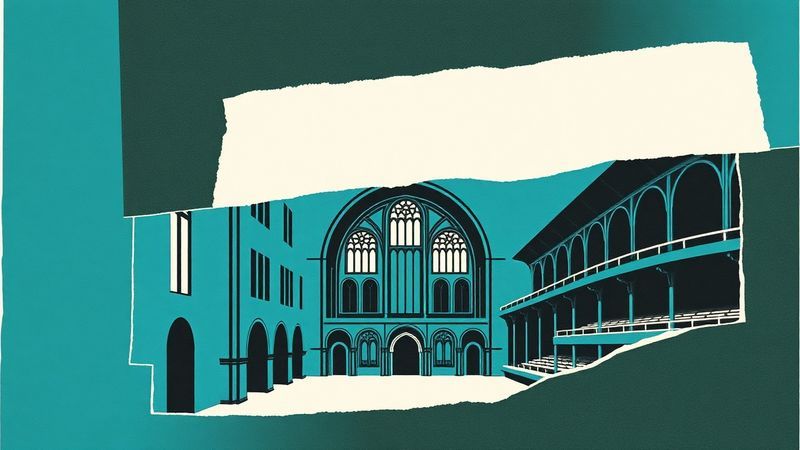
The reverberation is controlled to within a fraction of a second. Nothing surprises. Nothing comes back late. It works the way a perfectly calibrated hearing aid works — everything arrives, nothing is missing, and something is gone.
I have spent years staying quiet about what accessibility costs acoustically. Not because I didn’t notice. Because every time I thought about raising it, I imagined the version where my observation becomes a reason not to build the ramp.
I was protecting access by hiding what I heard.
An architect I spoke with in Rotterdam in 2023 — she designs cultural spaces, she asked me not to use her name — said it plainly. I know the lift shaft kills the room. I spec it anyway because if I raise the acoustic argument, it becomes a reason not to build the lift. I have watched that happen three times.
She is protecting access by hiding the cost. I am protecting my aesthetic pleasure by hiding the exclusion. We are lying about the same room.

What neither of us says: acoustic engineers know how to preserve reverberation through accessibility interventions. Stone-clad ramps. Glass-walled lifts. Materials that reflect instead of absorb. The solutions exist. Nobody funds them because nobody admits the problem.
Georgina Kleege argued in More Than Meets the Eye (Oxford University Press, 2018) that the average blind person has thought harder about what seeing means than the average sighted person ever has. The same asymmetry runs through acoustic space. I know things about reverberation that the Bridgewater Hall’s acoustic engineer does not. Not because I listen better. Because I have no other way into the room. That knowledge exists. It is not being used.
Mia Mingus writes about access as a practice of love, not a checklist. Love names the full weight of what it costs.
I went back to the Janskerk in January 2024. There is a temporary ramp now, aluminum, municipal standard. I walked in alone for the first time. I clapped once. The sound came back in nine seconds.
This article was inspired by Support Disability Justice! (Campaign Update) from sinsinvalid.org.