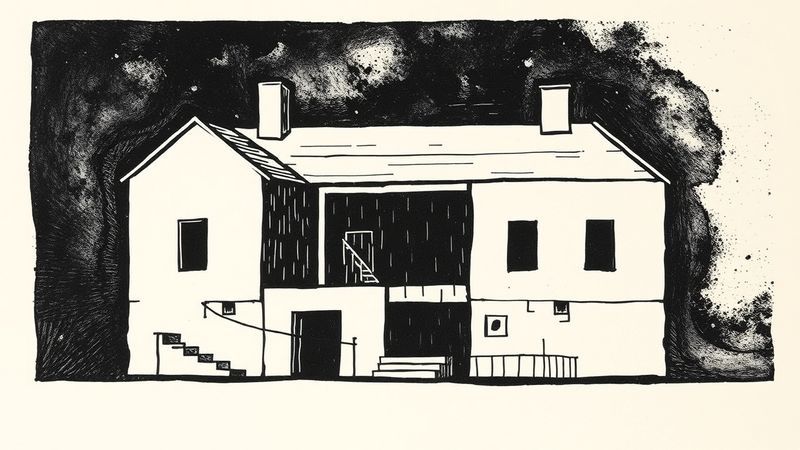

I want you to try something. The next time you walk into a building through its front door — the one with the awning, the signage, the warm light spilling out onto the sidewalk — turn around and look for the ramp.
It won’t be there.
It will be around the corner. Down the alley. Through the parking garage. Past the loading dock where deliveries come in and trash goes out. There will be a sign, sometimes, pointing you toward it. The sign will say “Accessible Entrance” with an arrow, as though the problem is simply one of wayfinding and not of worth.
I have been following those arrows for twenty-three years. They have led me through service corridors and freight elevators, past kitchen grease traps and recycling bins, into lobbies that were never meant to be lobbies at all — just the space that was left over after the real entrance was designed for everyone else. The arrow always points the same direction: away from the front. Away from the ceremony of arrival. Away from the implicit human right to enter a building as though you were expected.
This is the architecture of separate and unequal, and it has a building permit in every city in the world.
The physics of the detour
Let me give you the math of my morning commute in Philadelphia, because the city-as-obstacle-course operates on physics, and physics doesn’t care about intentions.
The subway station at 15th Street has two entrances. The stairs descend seventeen feet in approximately forty horizontal feet — a direct, efficient geometry that respects the passenger’s time. The accessible route requires me to travel to the elevator at the far end of the platform, which means rolling an additional 380 feet to reach the same train car a stair-user reaches in 40. The elevator, when it works — and I will get to the question of when — adds approximately four minutes to a trip that takes a stair-user ninety seconds.
Multiply this by every transfer, every station, every building I enter in a day. My city is measurably, physically larger than yours. Not metaphorically. Not emotionally. Literally. I travel more horizontal distance to reach the same vertical destination, every single time. The built environment imposes a mobility tax on my body, payable in minutes and fatigue and the particular humiliation of arriving late to a meeting that everyone else reached on time using a door that was fifteen feet from where I was told to go.
This is what I mean when I say the city is an obstacle course it refuses to admit it built. The obstacles are not natural features. They are not weather. They are design decisions made by people who had a choice and chose stairs.
Compliance is not welcome
The Americans with Disabilities Act turned thirty-six last year. In the decades since its passage, an entire industry has organized itself around the concept of compliance — the legal minimum, the checkbox, the ramp that exists on paper and technically exists in space but that no one who designed the building would ever want to use themselves.
I have spent the last four years mapping what I call the Compliance Gap: the spatial and experiential distance between the accessible route and the primary route in public buildings. My research team — three wheelchair users, two blind navigators, and an architect who started using a cane midway through the project and suddenly understood everything we’d been saying — has documented over 340 buildings across six American cities.
Here is what we found.
In 73 percent of the buildings we surveyed, the accessible entrance was not the primary entrance. It was a secondary door — side, rear, or below grade. In 41 percent of cases, the accessible route required passing through spaces coded as service areas: loading zones, mechanical rooms, staff-only corridors. In 22 percent, the accessible entrance was unmarked or marked only with a small international symbol of access — the little wheelchair icon that is itself a design artifact of the 1960s, depicting a passive figure being moved rather than a person in motion.
And in 100 percent of cases — every single building — the accessible route was longer than the primary route. Not once did we find a building where the ramp was shorter or more direct than the stairs.
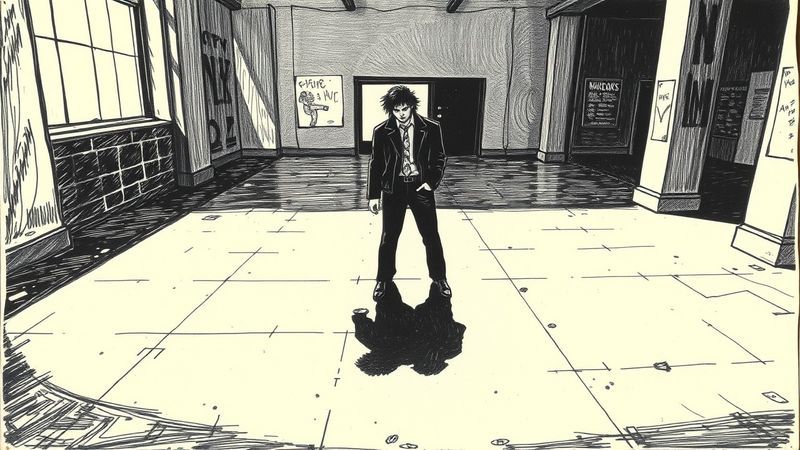 The back entrance — a service corridor repurposed as the only accessible route into a public building
That is not a sample bias. That is a value system expressed in concrete and steel.
The ceremony of the front door
Architecture has always understood that entrances are rituals. The portico, the grand stair, the revolving door, the threshold — these are not merely functional elements. They are performances of arrival. They announce: you are entering. They confer a kind of spatial citizenship. You came through the front. You belong here.
When I enter through the back, I am not performing arrival. I am performing exception. I am the body that the building was not designed for, being routed through the infrastructure that handles other exceptions — garbage, deliveries, mechanical systems. The building is telling me, through its geometry, that I am logistics. I am a problem to be solved, not a person to be welcomed.
And here is what makes this particularly insidious: the architects know this. Every first-year architecture student learns about the phenomenology of the threshold. They read Gaston Bachelard. They study the emotional weight of doors. They understand, intellectually, that how a person enters a space shapes their entire experience of that space. And then they put the ramp around the back, because the ramp would “disrupt the façade,” because the client didn’t want it visible from the street, because — and I have heard this from architects directly, in meetings where I was the only wheelchair user present — “the ramp is an accommodation, not a feature.”
An accommodation. Not a feature. As though my entrance is a concession the building makes, grudgingly, under legal duress.
The elevator question
I need to talk about elevators, because elevators are the place where the architecture of separate and unequal becomes the architecture of separate and conditional.
An elevator is not just a box that moves vertically. An elevator is a single point of failure between a disabled person and the rest of the built world. When the elevator breaks — and elevators break constantly, with a frequency that would be considered a public emergency if stairs broke at the same rate — the building becomes uninhabitable for me. Not inconvenient. Uninhabitable. The five-story office building where I consult three days a week has one elevator. When it was out of service for eleven days last October, I could not reach my office. I worked from home, and nobody at the firm said anything about it, because my absence was rendered invisible by the same logic that put the ramp around the back: I was never fully present in the building’s imagination to begin with.
New York City’s Metropolitan Transportation Authority reports that on any given day, roughly 20 percent of subway elevators are out of service. Twenty percent. Imagine if 20 percent of staircases were blocked on any given day. Imagine the headlines. Imagine the emergency repairs. But elevator outages are not treated as emergencies, because the people who depend on them are not treated as the public. We are a subset. A special population. An edge case in a system designed for the center.
I track elevator outages in three cities using a custom dashboard my team built, pulling data from transit authority APIs and crowdsourced reports from other wheelchair users. The average out-of-service duration for a subway elevator in Philadelphia is 14.7 hours. In New York, it’s 19.2 hours. In Washington, D.C., where the Metro was supposedly built with accessibility as a core principle, it’s 11.3 hours — better, but still the length of a waking day.
When I tell people this, they are always surprised. They have never noticed the elevators. They have never had to.
Crip time and the inaccessible city
There is a concept in disability culture called crip time. It means many things — the extra time a disabled body requires, the different relationship to productivity, the refusal to organize a life around the tempo of abled efficiency. But I use it in a specific, spatial sense: crip time is the time the city adds to my life by being inaccessible.
I have calculated my crip time tax. Over the course of an average week, I spend approximately 4.7 hours more than a non-disabled person doing the same things — commuting, entering buildings, finding accessible bathrooms, waiting for elevators, rerouting around construction that has blocked a curb cut. That is 244 hours a year. Roughly thirty full workdays. A month of my life, every year, spent navigating infrastructure that was designed without me in mind and retrofitted with the minimum legal effort.
 Arrival as architecture — the ramp as central gesture, not afterthought
This is not an abstraction. This is time I do not spend writing, researching, seeing friends, resting. This is time extracted from my life by design decisions I had no part in making, made by people who will never experience their consequences.
And the crip time tax is regressive, as all bad infrastructure costs are. It falls hardest on disabled people who are also poor, who are also Black and brown, who live in neighborhoods where the sidewalks are worse and the elevators are fewer and the buses with functioning lifts are rarer. The accessible entrance isn’t just around the back — in some neighborhoods, it doesn’t exist at all.
The lie of retrofitting
American disability access is, overwhelmingly, a retrofit. The ADA did not require that the built world be torn down and rebuilt. It required reasonable accommodation — a legal phrase that contains its own limitation. Reasonable to whom? Accommodation of what? The law treats access as an adjustment to an existing system, not as a fundamental principle of the system itself. And so we get ramps bolted onto the sides of buildings like prosthetics the building didn’t ask for. We get platform lifts that require a key from the front desk. We get automatic door buttons placed behind doors that open outward, so that pressing the button means being hit by the door.
I am not making that last one up. I have a scar on my left hand from a door at a county courthouse that opened into the button that was supposed to open it. The building had been certified ADA compliant.
Compliance. The word itself is revealing. You comply with an order. You comply with a demand. Compliance is the language of resistance — the minimum you must do to avoid punishment. It is not the language of welcome, or design, or imagination. When a building complies with the ADA, it is telling disabled people: we did this because we had to. The architecture communicates this clearly. The ramp is steeper than it should be (but within code). The doorway is exactly 32 inches (the minimum). The bathroom is accessible (but there is one, on the third floor, and the sign is small). Everything meets the standard. Nothing exceeds it. Nothing suggests that the architects lay awake at night thinking about how to make a disabled person’s experience of the building beautiful.
What beauty looks like from a wheelchair
I want to talk about beauty for a moment, because it is not a word that often appears in discussions of accessibility, and that absence is itself a form of exclusion.
I have been in exactly four buildings in my life where the accessible route was the most beautiful route. Where the ramp was not a concession but a feature — a generous, curving path that offered views the stairs did not, that moved through the building with a grace and intentionality that made me feel, for once, like the building had been designed for my body.
The Moesgaard Museum in Denmark, where the accessible path follows the building’s sloping green roof and arrives at the entrance through a landscape that stair-users miss entirely. The Ed Roberts Campus in Berkeley, where the helical ramp is the building’s central architectural gesture — its spine, its signature, its most photographed element — and the stairs are tucked to the side, an afterthought for the walking. The National Museum of African American History and Culture in Washington, D.C., where the accessible route through the history galleries is not a parallel track but the track, because the curators understood that a history of oppression should not reproduce the spatial logic of oppression.
These buildings prove that it is possible. They prove that the ramp-around-the-back is not an inevitability but a choice — a choice that most architects, most clients, most cities continue to make because they do not see disabled people as the audience